


The GLP-1 Fairy Tale: Reach Your Goal and Stay There Forever?
My Take from ObesityWeek 2026: CagriSema, changing food cravings, and why I think we’re still asking some of the wrong questions about obesity care.
We’ve been sold a pretty appealing bill of goods about GLP-1 treatment. Take the medication, follow the plan, lose the weight, and keep it off with a maintenance dose. But what happens in year two or three when weight loss plateaus before you’ve reached your goal, even though you’re doing “all the right things”? What happens when food noise returns or you begin regaining while still taking your medication? We spend plenty of time celebrating the remarkable weight loss these medications produce, but far less talking about why patients hit that ceiling and what happens next.
After four and a half years interviewing obesity researchers, clinicians, and patients, I went to ObesityWeek with plenty of questions. I came home encouraged by the science and how much more involved patients were in conversations about their care. But I also heard familiar assumptions about food choices and accountability that made me question whether we’re paying enough attention to how these medications change our bodies and brains.
I’m going to share what we learned about amylin, glucagon, and the next generation of obesity treatments, along with what happened when my Cozy Butter cofounder, Amanda Bonello, and I worked alongside physicians on two patient cases. Then, in Kim’s Take, I’ll dig deeper into the questions I think we’re overlooking, why I’m interested in CagriSema for my own treatment, and my theories about personalized dosing, returning food noise, metabolic adaptation, pricing, and Lilly’s retatrutide strategy.
The Science Presented at ObesityWeek 2026
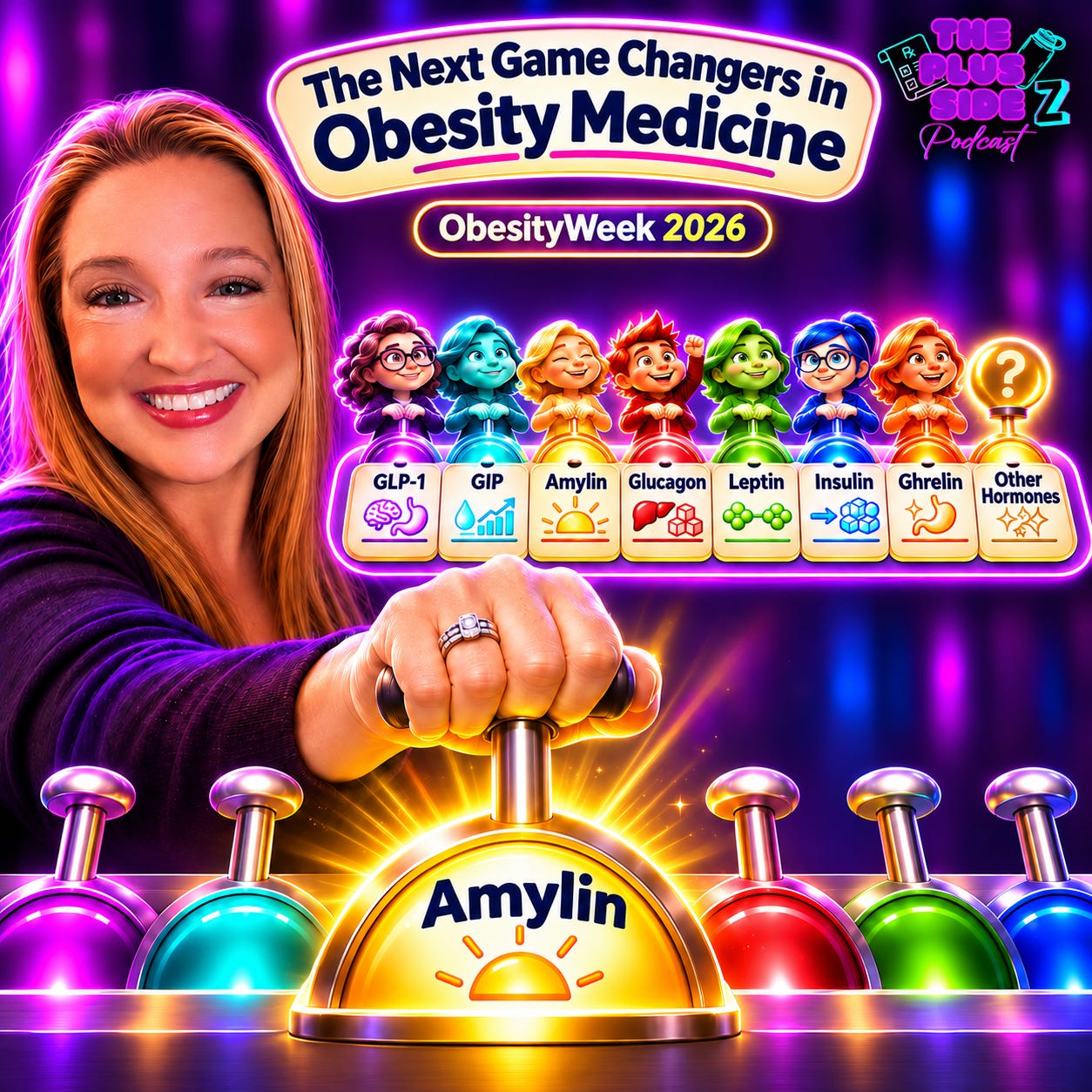
At ObesityWeek, a presentation about amylin, a hormone that helps signal fullness to the brain, drew so much interest that people were spilling out of the conference room. I think so many people wanted to learn about it because adding another hormone pathway could help patients get further toward their weight-loss and health goals. Novo Nordisk has already submitted CagriSema, which combines semaglutide, the GLP-1 in Wegovy, with an amylin-like medication called cagrilintide, to the FDA for approval. We could see it on the market as early as January 2027 if approved.
Researchers also presented trial findings showing that people taking cagrilintide reported fewer cravings for sweet and savory foods and greater control over those cravings compared with placebo. But does adding in cagrilintide help people eat even less than other medicines and that’s why the weight loss average is higher, or is there more to it? Spoiler alert, there’s more to it!
Even now, when patients plateau or begin regaining weight while taking their medication, I still hear some doctors blame patient noncompliance or say they’ve fallen off the proverbial wagon. And oftentimes their habits really have changed. But why? Could returning food noise, metabolic adaptation, stress, or hormonal changes during perimenopause and menopause be influencing those behaviors? YES! Could their medication be regulating appetite and satiety less effectively than it once did? We need to ask those questions before assuming patients simply aren’t doing enough.
I have said for years that the types of foods I wanted changed, and it’s what made my “lifestyle” possible to change. The disease was driving my food choices before, but with GLP-1, I was in the driver’s seat and not being tortured by food noise. My road now. My rules.
Amylin: The Next BIG Game Changer in Obesity Medicine
In the REDEFINE 1 trial, researchers gave every treatment group the same recommendations: a 500-calorie daily deficit and 150 minutes of physical activity each week. Yet participants taking CagriSema lost an average of 20.4% of their body weight over 68 weeks, compared with 14.9% on semaglutide alone. Everyone received the same lifestyle change guidance, but adding amylin produced greater average weight loss.
Outside of ObesityWeek in September 2026, a different study gives us another piece of the puzzle about why foods patients once felt driven to eat can start to lose their appeal. Researchers looked at how CagriSema changed the brain’s response to images of high-calorie foods. After 52 weeks, they found changes in areas involved in cravings, reward, and control over eating. CRAZY!
And BAM! We’re seeing evidence that these medications can change how strongly we crave certain types of foods, along with how much we want to eat. I’ve heard patients in my community describe this for years, and I want to see more research into how treating obesity’s biology influences the choices we make about food. There is a difference between appetite suppression and satiety. Calling all researchers, please study this!
Glucagon: Another Lever for Metabolic Health
Amylin wasn’t the only hormone getting attention at ObesityWeek. Another presentation, “Glucagon’s Role in Metabolic Regulation and Why It Matters,” explored how glucagon influences the way our bodies process and use energy. As we lose weight, our bodies naturally burn fewer calories, and metabolic adaptation can make that decline even greater. Patients can continue taking their medication, eating the same way, and staying active, yet plateau before reaching their health goals.
Researchers are studying glucagon’s effects on how our bodies use energy and process fats and sugars. I’m interested in whether adding this pathway could eventually help patients who’ve reached a plateau make further progress without restricting calories to unhealthy levels or exercising more than is realistic.
Eli Lilly’s retatrutide targets three hormone pathways: GLP-1, GIP, and glucagon. Its Phase 3 trials have produced some of the strongest weight-loss results we’ve seen, with participants taking the highest dose losing an average of 25% of their starting body weight over 80 weeks, compared with 3.9% on placebo. Researchers are still determining how much glucagon contributes to those results, but I’m particularly interested in what this additional pathway could mean for patients who’ve reached the limits of their current treatment.
Retatrutide remains investigational, and several people I’ve spoken with in obesity medicine and pharma believe it could still be 12 to 18 months before patients can access it. Some suspect Lilly’s push to have retatrutide classified as a biologic could affect that timeline. I’ll dig further into that theory and what competition with CagriSema could mean for patients in Kim’s Take.
The Questions Are Part of the Care
One of the biggest differences I noticed at ObesityWeek this year was how much more patients were included in the conversation. Last year, patient involvement felt limited, often featuring familiar faces from pharmaceutical campaigns. This year, TikTok advocates joined panels, patients shared their experiences alongside physicians, and doctors genuinely wanted our input. I found that encouraging, although familiar, comments about food choices and accountability reminded me how much work remains.
One doctor in the audience talked about not giving babies apple juice or kids Coke, while the doctor right next to her took a big gulp of her own Coke. It was hilarious! I don’t think any more lessons in restriction are going to get us where we need to be. Drink your Coke, girl! LOL
My Cozy Butter cofounder, Amanda Bonello, and I joined an interactive session where patients and physicians worked through two cases. The first involved a 16-year-old living with obesity whose knees hurt and who had finally found the courage to ask his doctor for help. One pediatrician explained that a 15-minute appointment might mean bringing him back for another visit. Amanda and I challenged that approach. If this kid leaves without a plan or clear next step, what are the chances he comes back? We think low.
The discussion turned to fast food and whether he was eating too much of it. But he’s 16 in America! He’s trying to fit in, make friends, and figure out who he is. At that age, I carried a Weight Watchers journal around with friends and even on dates, calculating what I was allowed to eat. It was embarrassing and isolating, and I don’t want another generation growing up feeling that way.
Amanda and I also suggested connecting teens with other kids living with obesity to create community and connection. After watching a panel of teenagers at the OAC Your Weight Matters conference describe how much finding that community meant to them, I think belonging deserves a bigger place in treatment.
The second case involved a 73-year-old woman caring for her husband with Alzheimer’s while managing her own health. I loved hearing one physician acknowledge that she was still trying to eat well and stay active despite everything she was managing. I brought up that someone in her age group had likely spent decades immersed in diet culture.
I also shared that the “What I Eat in a Day” trend is one of the internet’s biggest food trends, racking up over 15.9 billion views on TikTok alone and fueling millions of video uploads across social platforms. Diet culture has screwed us up so much that we’re all professional dieters, yet we have no idea what to eat in a day. Another clinician shared a simple approach: offer patients a few nutritious foods and different ways to prepare them, then let them choose what they enjoy. The point is, we need to include patients as part of their care team and customize care where possible.
As we worked through these cases and shared our different perspectives, we heard each other. You could see heads nodding and people getting excited! At one point, while summarizing our discussion for the table, I said, “I think the questions are part of the care.” In product management and product marketing, we call that discovery. And it blew me away because I saw the doctors on the panel’s mouths drop. They said, “The questions are part of the care! YES! Someone write that down!”
I remember my sister talking about how doctors sometimes needed to see her as a science experiment to handle the stress of their jobs, and she understood why. She passed away in March 2026, but she loved her team of doctors. I kept thinking how much she would have loved seeing these doctors hear us, see us, connect with us, and work toward a better way to treat us. It was so encouraging.
Patients live with this disease every day, and our experiences, circumstances, and goals should help shape our treatment instead of some random BMI that no one agrees is a good measurement of health. As we develop more medications and learn which biological pathways to target, I want to see that same curiosity guide how doctors care for each patient. Now, as a tech marketer, I get that this doesn’t scale right now. But I have hope and can’t help but wonder if AI could help make this kind of customized care possible at scale. Wouldn’t that be interesting?
Kim’s Take For Paid Subscribers
After ObesityWeek, I put on my marketing hat and started thinking about what comes next for Novo, Lilly, and the patients who’ve already spent years on GLP-1 medications. I have some theories about why patients switch treatments, what CagriSema could mean for people like me, and how the competition for market share might influence what happens next.
For my paid subscribers, I’m sharing my predictions about pricing, insurance coverage, and retatrutide’s path to market, along with the research questions I think pharmaceutical companies should be asking. Some of my theories might be controversial, but after four and a half years talking with patients, researchers, and people across the industry, I think I am connecting some dots that aren’t mainstream yet, and maybe they can be.